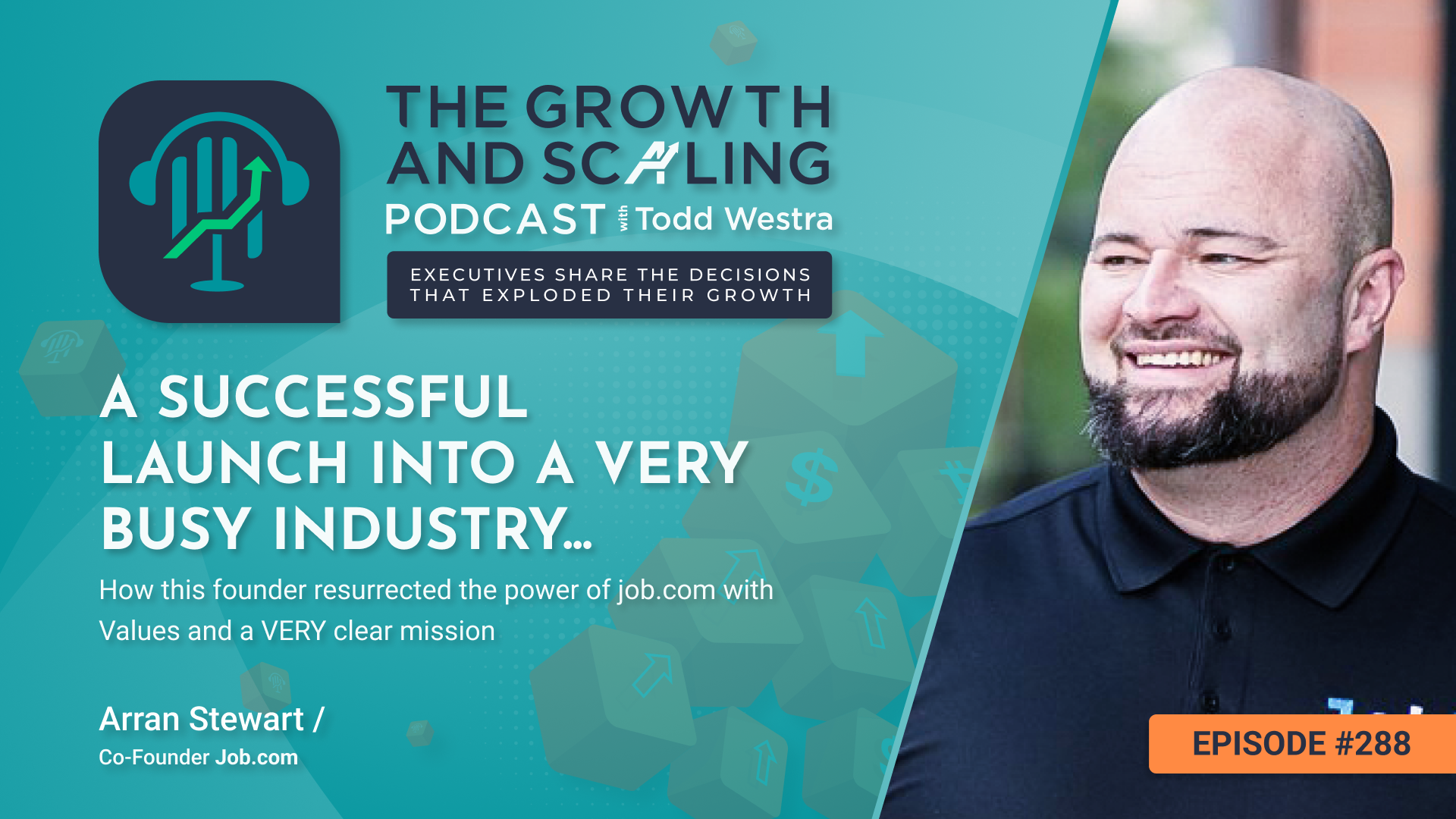
Episode 288 - Arran Stewart/Todd Westra
Todd Westra
Arran Stewart
02:57 Hey, welcome to another episode of the
Growth and Scaling Podcast. And today we are so thrilled because yes, you know,
it's very rare you get someone like a guest we have today who has a three
letter .com on his business name. It is the job.com and that is even harder, I
would assume, to get than just some random acronym. So we're gonna jump into
how he got that, how he got his business started. He's a great man, great dad,
and a great business leader. We welcome Arran to the studio, Arran, tell us who
you are and who do you try and who are you trying to help?
03:31 Thank you. So listen, Todd, thank you
so much for having me on and uh, yeah, Arran Stewart. I'm the co-founder, chief
visionary officer of job.com or ‘head nerd’, I probably described myself as
that. Um, we have a pretty straightforward mission at the business. Um, which
we tell everyone in the company and we always emulate, which is we are here to
help as many people feed their families and pay their bills as possible. That's
what job.com does, hence the name. And, uh, and it's something that, you know,
myself as a, my entire life, my entire career has been in recruitment, HR,
tech, human resource technology, and I dedicated my life to that mission to
help people feed their families and pay their bills.
04:11 I love it. I love it. I, I would dare
say that there's probably very few people. Even business leaders who know their
mission statement and can rattle it off like you just did. I love it.
04:19 Oh yeah! I live by it. So, um, and, uh,
it's because, you know, it's something that I guess as we probably go through
this podcast, I'll explain more of my story, but it resonates so closely to me
because of my life and upbringing and everything else.
04:32 I love it. Well, before we get to your
upgrading upbringing, I wanna hear. First of all, like being in HR is one
thing, but getting the name job.com, that is something different. And how did
you actually get that? How did you, how did you work towards this mission
anyway? Like, I don't know, maybe this will did to your upbringing, but
something to the other stuff.
04:55 Yeah, so should be fair. So, I founded
the company in uh uh, at the end of 2011. So we are 12, 12 years in now, but it
wasn't called job.com back then, it was called MyJobMatcher, which is a real
mouthful. Um, yeah, the object. The object, which everybody would say wrong.
Myjobmatcher, myjobmatch, myjobmatchmaker, you name it. They would think of
whatever to call it other than its name and uh, but the objective was, and at
the time, statistically in the United Kingdoms, I'm British, even though I live
here in the United States, but this was, I started the company originally in
the United Kingdom. Um, statistically the average job seeker would spend 7
hours a week looking for work online and would register with 21 separate
employment sites, 20 logins, user interfaces, technical capabilities. And I was
like, it's a job looking for a job and,
05:43 You gotta be kidding me, 21 separate
sites?
05:46 21 separate sites. Yeah. This is the,
those were the stats for the market. And I was like, well if we combine
artificial intelligence with job aggregation, we can utilize match technology
to search for jobs that match a resume every single day. And thus was created
my job matchup. And it grew very, very fast in the UK, Um, obviously much
smaller country, but 7 million people registered on the website. And there were
sort of three of the working population. And that meant we got a lot of, in,
uh, a lot of interest from institutional investor cash, so VCs, PE. We took in
our first institutional cash in 2016 and we decided that we were gonna come and
try and, you know, let's go to America. And, um, and so, you know, quite
naively and bravely as entrepreneurs do, jumped off the cliff figuring out how
to build a plane on the way down.
06:35 Welcome, welcome!
06:36 Yeah, welcome. Yeah. We, we, we landed
in the US in 2017 through acquisition. So we were like, we buy our build and we
acquired, firstly companies we acquired, were active hiring and zillion
resumes. And then it just happened in the summer of 2017, on the grapevine we
heard that job.com, um, was for sale as a business, and it had been operating
here as a job board since 1998. We approached the owner. Thought, you know,
what can we do and how can we make this deal happen? We sold him the vision of
the business. He fell in love with that and with a combination of cash,
earnout, and stock. We acquired job.com and thus now we own and have that
incredible URL business.
07:18 That is so awesome!
07:20 Yeah, yeah.
07:21 Holy cow. Dude. That is so red. And,
and the job.net, as well.
07:23 We do have job.net, so that was
actually part of the deal as well. So he owned both and um, Probably out of
respect, I won't say on the podcast how much he had paid for them, but I can
tell you, it was multiple seven figures in the 90’s.
07:41 Wow! Holy crap.
07:42 It's just, just for the URLs.
07:45 So, uh, during that dotcom boom, that
was like a, probably one of the big dotcom booms.
07:49 Yeah. Yeah, definitely. I mean, like
you said, three letter domain for the word of the industry, you know, and, um,
and to this day, you know, obviously the URLs are, you know, heavily valued on
our balance sheet, because I would argue that it's one of the most expensive
domain URLs in the world, probably. Um, it's gotta be, you know, so, uh, it's
definitely, it's definitely up there, that's for sure. So, and, uh, so yeah,
that's, that's, that's, that's the URL history of how we got job.com.
08:20 That is amazing. So, so let's take it
one step back then. 2011, you are in, what kind of scenario to drive you into
wanting to start a job? Matchmaker service. I mean, what were you looking for
work? I mean, what, what's kind of the backstory here?
08:36 Yeah, so actually we can take a little
further step back actually. So, I had, so if we go back to 2006, yeah. I had
finished college and was working for a publicly traded company called S3, big
Recruitment Staffing agency that had a technology division that owned a cool
website called the IT Job Board, and I was working there, and arrogantly
thought I could do it better. And left, left and started my first job board in
2007, which was called Jobs From Blue. And it was basically a networking
platform for blue collar workers to, uh, refer their friends to warehouse work
and, you know, industrial work etc.
09:19 I love it. I love it.
09:20 It failed. It failed miserably.
09:21 It did?
09:22 Yeah. It failed miserably for a
multitude of reasons. One, I was too young and too naive and way too arrogant,
and so I made so many mistakes. It was unbelievable, cause I was in my sort of
twenties at the time. Uh, it was hugely under capitalized because I had funded
it myself and naively thought you could launch a, you know, a website business
in a hugely competitive market where Monster and Indeed were dominated everywhere.
And I launched it with a hundred thousand of my own money and that was all they
had literally remortgaged my property, loans everywhere. It almost bankrupted
me that journey. Um, but during it, I received mentorship from a guy called,
uh, Alex Strang and another woman called Helen Reynolds, who kind
of gave me a bit of advice that, you know, maybe I could spin out a part of
the, the technology of the platform and thus was born another, my second
business, which was called I Resource. And that became sort of part of a Big P
house called Hamilton Bradshaw in 2009, and that was the turning point
for my business journey. Um, that was my first sort of taste, I guess, of
success in achieving something. And so once that had finished, then I'd, I'd finished
with my resource. I then set up my job, matchup with my business partner. Now,
Paul Sloyan at the end of 2011, that's how I got there. So I'd already done two
entrepreneurial, one screw up. One kind of success. And then moved to, you
know, my job.match now job.com at 2011.
10:53 I love it. But you, you were, you were
arrogant enough to launch a competing site to your employer, but you were
humble enough to receive mentorship and that's where you started to see the
success. Is that right?
11:04 That's, that's exactly right, yeah,
because what, what I realized was that, you know, I obviously didn't have all
the answers as much as I thought I did, cuz I've been like, well, I've done
this and I know this and I know that. And it was actually like, Funnily enough,
there are many layers and dimensions to this process called success and
scaling. And you don't, you know, about this much. And, uh, and, and I learned
that the hard way. So, uh, which I'm really grateful for now because it was the
most valuable lessons I ever had in my career I reckon.
11:35 Uh right. You kind of have to hit
that.
11:38 Oh yeah, you do. You, you, you have to
have the, the rock you have to hit the rock bottom, I think to truly build
yourself to be where you want to be. It just doesn't happen where you just fall
out and go, oh, I created a great business and it was seamless. There was no
issues. It's like said nobody, you know?
11:54 Very, very rarely.
11:55 Very, very rarely. And normally if they
do do that, it's because there's a huge backstory of all the lessons they learn
whilst maybe employed or you know,
12:04 How would set up the..
12:05 Or you just, you'll just walk out.
You're just a, automatically a entrepreneurial God, you know? It just doesn't
happen, you know? So, uh, It takes those moments to truly craft you, and it's a
test of character. Because a lot of people give up and that's the reason why
some, these people, those people, yeah, they do the line is 99% of people will
give up and then there's that 1% of lunatics like us lot that still keep going
for punishment. And then in the end, with enough, you know, enough inertia, we
seem to start to break through and gain some traction. So, uh,
12:38 It feels good to fail sometimes. Come
on.
12:41 Yeah, it does. It will. It, I guess,
when you start to appreciate the value of failure. Which is, you know,
absorbing that knowledge, taking that wisdom, it's, you realize just how
valuable those moments truly are and how much you grow from them. And, so,
yeah,
13:04 So looking back on this journey, I mean, you, you, and, and, and I know
that, uh, at some point you're gonna want to throw in here just even the
backstory behind. Why you were looking for jobs, why maybe you had this, this
arrogance about you, but like, maybe take us through a little bit of that, and
then feed us into the growth journey that you've had in your business. What have
been the favorite highlights along the way? Like what are the, what are the key
points for you? like, yes, yes, this is gonna work and this is gonna go.
13:37 Yeah, good, good point. So, uh, well,
backdrop. Um, why was I driven to help as many people feed their families and
pay their bills as possible? Well, yeah. Uh, I grew, I grew up in a, I grew up
in, uh, economically and statistically the worst place to live in the whole of
the United Kingdom called Gluten Town, uh, every year voted that, former Buick
Manufacturing town, 250,000 people, all manufacturing left the town and it
became a crime hotbed. Um, I had some very close friends, one in particular,
uh, called Noe Whelan. And I watched some of the journey of people like him and
his family who lost their ability to work and feed their families and pay their
bills, which inherently, um, drove, uh, very negative behavior. Alcoholism,
drug abuse, et cetera. And, you know, Noel's one of my best, bestfriends. My
son's middle name is Noe. I lost Noel in 2014. He died. I lost him. Yeah. And,
uh, I realize how important the premise of people being able to feed their
families and pay their bills truly is. Um, because they're saying it's right.
The devil makes work for idle hands, and
yes, it does. It certain, it certainly does. I watched it, I lived it, and I
also experienced it by doing, uh, negative things. You know, as we discussed in
my teenage years. Living that life. You know, as I share with people, sadly,
you know, I am a convicted felon. I made mistakes I, my hands were idle, and I
made those mistakes. And I also realized just how important it's not just for
others to feed the families, but for me too. By doing good work, doing the
right work. So that's the backdrop to my motivation. That's why I can tell you
my mission without having to even think about it, because it is the DNA of the
business.
It's the DNA of myself.
15:27 Love it.
15:30 Going to the next part of your question
and you'll see what you know asking about the story and scaling. Spend a lot of
time on job.com. So we had, I'm gonna be pretty brutal to myself and go the
beginning of my job matcher, which we'll just say job.com cause it's just
easier. But the beginning of job.com, when we first launched, it was successful
almost by, And, and what I mean by that is when I think about the energy that
went into thinking about scaling the first part of the business, it just, it
just happened And so like, we just suddenly like launched it. It was published
on like BBC News cuz it was like this brand new site that can, like, you don't
have to search anymore. The AI doesn't, well it was a new thing, it was a new
thing, a new shiny thing and everyone wanted a piece of it and so it just stale
grew and we were like, this is great. You know, this is so exciting. And then,
but then came the true challenges because we worked on what's called a
partnership model where we would activate our partner's data and send those
users, uh, job seek, uh, job matches every day. And then the, the, the, uh,
data privacy laws change with GDPR in 2015. And literally just put an Acts
straight through it, and we were like, We can't do that anymore. And then
suddenly the tests of our business model came and it was like, okay, now it's
not so easy. This is really much harder to try and generate a response. And
then another acts that came through to us was the United Kingdom has a thing
called universal job match, which is where as a provider or an advertiser of
jobs, you can reach all of the people that are on what we class, a social
welfare, who are like looking for work, being paid by the government whilst
they're unemployed, and there are several million people at any one time. And
it would generate huge levels of click response and revenue for us as business.
And in 2016 the government went, we're turning it off. We believe it's
anticompetitive. And we were like, oh no. We're like, what? Why? So we, so we'd
had this burst of growth and now we're going backwards at as fast as we came.
And I'm like, oh my gosh, this is a nightmare. I'm like, okay, where can, what
can we do to, you know, continue this growth structure in like, America,
America, you know, the, the, the data protection laws are a little bit more
lenient there. And also, you know, this is land of opportunity. The economy's
10 times the size when it comes to our industry. Let's go to America. So, so we
did.
17:56 Hey, little, little secret. You're not
the first ones to come from the UK over to over to America.
18:02 Apparently there's some history behind
that. I'm not sure what it is.
18:03 A little history behind, there's a
little history behind that one.
18:05 Yeah.
So, So, uh, so we have little history behind that one. So we did that. We came,
we came here and uh, and then when we arrived, which was 2017, you know, we'd
been back, you know, with some institutional capital, which was great. And we
were like, okay, you know, buy or build. And we were like, we're gonna buy it.
We're gonna buy it first. Cause we don't know any, this is 50 countries in one
country with all the different state laws. And you know, it's just like, you
know, for us bricks, it was. This was, this was like a landmine of like, oh my
God!
18:36 That is intimidating, that is
intimidating.
18:37 Oh, it's terrifying. It was terrifying.
So, and then when we analyzed the market, we looked at like the direct
competitors, which were like indeed.com, ZipRecruiter, and it was very, it was
very daunting cause we were like, okay, these guys are, you know, huge. They
are huge. Like they, they are anxious next to what we experienced in the Arctic
Kingdom. And it was at that point where we reflected on the business model and
were like, I don't think we can compete. And it was, and it was like we sat
down as a, my business partner and I, Paul Sloyan, who happens to also be one
of my closest friends ever, mentor brother, everything. We looked at each other
in the eye and we're like, what do we do? And we, and that was the first time
ever that I would say we really strategically analyzed the entire market of
hiring and when, where can we transform where can we make impact. And it was,
and it was in the recruitment and staffing industry. You've got 20,000 staffing
agencies operating in America. 19,800 of them do under a hundred million in
revenue. So it's this huge, small, highly fragmented industry. But, like every
market is going through digital transformation where you pair a software with
humans to deliver a more effective process. And I was like, right, could we be
an e-staffing platform? Could we be digital? So could we be the Amazon to the
Walmart. You know? And that’s was built job.com and what we have today. And it,
and it, and it just that.
20:13 That's amazing. And, and since that
point, since that point, you, you had a couple of key acquisitions. And you
grew and now you are revenue wise, you're, you made it hundred like
you're?
20:24 Yeah. So we're we did 109 million in
2022. So we did 46 million in 2021. 109 million in 2022. Uh, this year
the rate that we're going, we should hit about 250. Um,
20:37 Woah!
20:38 And yeah. Yeah. So, so, you know, we,
we really are well on our way now and, uh, you know, we have a huge tech stack.
We've got a ma we like, we've done a huge protect cuz this is the thing. Now
when you look at, so there's 228,000 recruitment consultants in, in, in
America. Yeah. And all of them are now going through digital transformation,
which is where you take a human process and pair it with software. Well, now,
so it means that all of that process can be patented. So, we have filed, we
have filed 75 patents, we've had 23 granted, and we have 207 trade secrets in queue.
To take, to take ownership of this market as it goes through full digital
transformation. The goal is to get to a billion in revenue by 2025, 2026 and I,
I believe that we are gonna do it. You know, we are really growing a, an
incredible rate.
21:30 Well, you know, jumping from 40 to to
109 in, in a year where, you know, arguably it was one of the worst economies,
uh, in America for a long time, that is awesome! It's so cool!
21:44 Yeah, it, it, it's good and it's nice
as well cause unlike other tech companies, we are a, a very profitable
business. We run a really strong EBR so, um, and, uh, which is nice and,
uh,
21:53 It is nice.
21:54 Yes. That is nice. So, but it's the
whole.. it took me 10 years to become an overnight success kind of thing.
22:00 I get it man. There is, there is no
one here telling you you got lucky. Because it is a lot of hard work to get to
that lucky point, right?
22:10 Yeah. It, it, it certainly is. And uh,
and listen, there's a lot more work to be done. What I love is the fact of how
many people's lives we've touched, you know, how many candidates have gone
through our process? How many have, uh, have managed to better feed their
families and pay their bills? I love that every day that is happen. We are so
blessed at the company. We have such a good team of humans that work in the
business.
22:31 I love it.
22:32 Like I'd love to be like, oh yes, it's
me and the other founder. You know, we, we've done it all. No, we have a
phenomenal team of people that work with us who break their back trying to make
this happen. And we work so well collectively, and they believe in the vision
and the mission, which is to help people feed their families and pay their
bills. It's the, the opening, the lock that, you know, I sort of hand that
baton of, you know, this is what we are here to do, and, and they, they carry
that torch with pride and I'm very proud of everyone we have in the business.
23:01 I love it. I love it. Absolutely love
everything you've said. I mean, this has been a fantastic interview in that I,
I love the mission. It was made clear from the very start. It's, it's like
you've got this backstory, but the backstory doesn't mean anything compared to
what you've done with the backstory. You know, it's like, There's a lot of
people with backstory, but there's very few people that can take that and
translate that into such forward propulsion and helping so many people.
Ironically, for everyone to know, and you can look it up on his LinkedIn, he
went to Nottingham University and so like he, he literally is like taking from
the rich, giving you the poor.
He's helping people on their journey to
sustaining their family.
23:43 Yeah. Well I appreciate that and I
think one personal thing I think I share, which is as I sort of said earlier,
which was, so I made some mistakes when I was much younger. Cause I grew up in
this sort of toxic environment. I did. And I was, I was a, yeah a criminal. I
did, I did those things. I am a convicted felon. Um, uh, I have been for a good
portion of my life, uh, If I'm honest, driven by guilt from my behavior to want
to do as much good as I possibly can, so, right. So, so, so I love our mission
because I want to counterbalance the negative inputs I put into my universe
with as much good as I possibly can. I've probably reached a point now where I
feel like a immense has been made, if I'm honest. But there is a, a good
portion of my life. Twenties, early thirties, where I was like, I need to do as
much good as possible to make amends for the things that I did wrong. And, uh,
and that's been my driver.
24:41 Listen. Arran, that's, that's an
awesome driver. But I think it's time to convert that to just, it just feels
good to help people, right?
24:49 It does, does feel good to help people.
Yeah, it does. I love it.
24:52 It just feels good. Yeah. And, and for
those watching, I mean, honestly, when you think about your business model and
you think about what you're doing to drive revenue for your company and how who
your target audience is, who you're trying to help, who you're trying to serve
in your business, you really need to think about how good does it make you feel
to do it. It's a huge, huge driver. If, if what you're doing as a business just
sucks because you're working with shady people doing stupid things, it's not
very motivating. It's not very exciting. But when you've got a mission and when
you that, that mission can be set in the open and people will look at you and
say, hey, that's a good mission. People will jump on board and they'll see your
vision and they'll go with you. Would you say that's probably accurate?
25:35 Oh, I, I agree with every words. And,
um, what some people don't realize is that, doing negative things or doing
businesses that maybe are, don't have a positive impact or, or, or don't really
offer a true tangible, they're, they're not driven to do good. It doesn't just
take from those that you are, you know, making a commercial buck from. It takes
from you too. We are human. Human beings are not driven to be bad. We're not
built really to be bad. Our, you know, for whatever reason, I feel like we just
get misguided. But it feels so good to do good. And it is so good for the soul.
Like, it really is. I can't, it really is. I've believed both.
26:20 And when you're trying to and when
you're trying to build a team of like the best of the best and really great
people, if they have two choices between two opportunities, they're gonna pick
the one that feels better everytime.
26:31 Of course they will. Oh, absolutely.
You know, the, you know, fulfilling self-actualization, all of these various
components as well. Just again, I think we've been very fortunate to have such
an amazing team join us and get the inertia and traction that we have and we
continue to thrive. And, um, you know, it's, uh, we are here to do good
work.
26:53 I love it. I love it, Arran. Every
business has those moments where you're like, oh my gosh, are we gonna make it?
And they, every founder I've talked to always has someone they can point to and
say, I felt inspired and driven because that person had some kind of impact on
me. Who's your shout out today? Who do you wanna give some, some kudos to that
kind of helped motivate you to keep on going?
27:14 So, interestingly enough, because it,
he, so he is my business partner Paul. And the reason I say Paul, Paul, so
amazing, because, so Paul is 12 years older than me, which I, I love to you
know, make sure that he realizes that he's substantially older than me. So, but
at the time when we got into business together, the age gap was much more
prominent in a sense of, you know, this was a human being that took a shot on a
young man. And believed in me and supported me and mentored me, but also at the
same time, you know, gave me the respect and honor to be an equal right
business partner. And there's been many times where, you know, I felt like
threatening the towel, tearing the, the last fragments of my hair out. And, uh,
and, and he has just been there every step of the way. And now we have built a
hugely successful business together that we reap the benefits from and
everybody else does, who works for us, and all those that we serve. I would not
have been able to do it without him. No way.
28:09 I love it. I love it. That is so, that
is so great to hear. Even after 11 years of business together, 12 years, 13
years of business together, uh, you know, business partners. And that
relationship in and of itself is a study of patience and love and uh, you know,
it is not easy at times. It's great at other times, and sometimes it's like, oh
my gosh! But, but to hear the love and respect that you just expressed to him,
that is a, that is really impactful to me, having had partners in the past and,
uh, way to go, way to go. Listen, how do people follow you? Are you present on
social media anywhere? What, what kind of, uh, legacy are you leaving?
28:49 Yeah, so interesting. So I have
different dimensions, right? So obviously you can follow me on LinkedIn, Arran Stewart, which you'll get just the professional
ends. Twitter, I am on Twitter as well, but in twitter's more of a
broadcast of my LinkedIn, but I'm also on Instagram. And on Instagram I provide
several lenses to being a businessman, being a husband, being a father, and
also being a person that's phonetically into powerlifting. Um, and, and, and
just, and training. So I share all of those dimensions of my life on my
Instagram and, and kind of, you know, and, and have, you know, somewhat of a
following on Instagram now that, that people that watch me and see those, those
several dimensions to me.
29:26 So that's awesome. That's awesome.
Yeah. I was gonna guess you had some kind of association with powerlifting. I
mean, you're shirt looks like it's probably a size small, but it's probably an
extra large. So,
29:37 It it, this, believe it or not, this is
a triple XL. So I, I am, I'm a big human, I'm like 265 pounds, so yeah. I, I,
yeah, I'm a big, I'm a big human, so, uh, and, um, but you know, I, I've been
lifting for 21 years and 20, 22 years, goodness. 22 years. And, uh, and, you
know, and, and power lifting has been a big part of that. And, uh, and I
thoroughly enjoy it. It's my escape, right? it's my moment. And my wife is a
huge fitness fanatic as well, so it's something that we share together.
30:10 I love it. Well, listen, we have all
been blessed by hearing your story, by hearing your journey and, and those
listening who are really at that point where they're like, man, can this
business really do what I think it can do? This should be an inspiration to
you. I appreciate you guys being on today. Share it with people who need to
hear this cuz this is a fun story. And uh, Arran, thanks so much for being around,
bud..
30:31 Thank you so much, Todd. Thank you so
much for having me on. It's been great. Appreciate it.
2023 The Growth and Scaling Podcast, Inc. All Rights Reserved.


